Posts

Showing posts with the label Reading

Reading About Game Stories

Image
In this reading session we'll be talking about if games can be artistic and can we make a game be fun from a mechanical standpoint as well as from a narrative and story point of view. In this article  we talk about what art is and how that art is portrayed. It speaks about six layers of art: Idea/Purpose Form Idiom or genre Structure Craft Surface Story Telling Outside your heaven Link Here These are taken in the literal sense of each word; meaning that each layer describes its 'piece' of art and how its represented in our physical world. These can also be taken in any order you wish but they all link together  to make something. A comic for example; its given form, then you see the surface of it, being the art and lines, and then looking deeper for the story and how its crafted to make it compelling and this leads to a genre and this will head towards a message being portrayed in the comic itself. This can be linked to games as well in near enough the same or...

Reading about game fun

Image
In this weeks reading, we'll be learning about player fun and how to incorporate it into our project. Game MUD Achaea Worlds leading MUD Link Here In this first article , it describes the fun that the player experiences to be them learning about the game while in a fun flow state. Next it breaks down some of the fun factors into some categories like; Sensation, Fantasy, Narrative, Challenge, Fellowship, Discovery, Expression, Submission. These can be attributed to what a player wants and feels when playing a certain game. Some of these are playing a game on a consistent basis with people you know or how we portray ourselves in said world through our character. This is interesting in the fact that while you think that all games should follow this, its in fact something different. We should focus on the fun that's most appealing to our game and how we want to present that to people who might be interested in playing it. Don't work for all round game, specialize on wha...

Game Flow Theory and Decisions

Image
In this weeks reading exercise we are looking up game decisions and flow theory on what makes a game stand out and what puts players into a 'flow' state where you're 100% into the game. In this first article  we talk about how certain games have decisions that give the player a motive to play; in essence, something that is completely in their control of what to do. An example of some games with minimal decisions in them are gambling games as they generate their fun factor from the chance of winning something. It then goes on to give out tips on what not to do when designing a decision for the games like, not having meaningless decisions as to make each choice a risk in of its own. Here  is when I found the article interesting. The article goes into detail on how to make a good decision on what a good decision should act out like in your game. An example would be having risk versus reward so to give some weight to a decision you make and if it should be chosen in the first...

Reading about Games GDD

Image
For this week we'll be reading up on the iterative process of initial design. Design choice Network topology design consideration Link Here In this post about the early stages of design process , I found it helpful and slightly interesting as the post suggests to keep copies and a permanent of all your ideas, mechanics stories and everything else that you think up when designing a project. Another is to jot down critiques about games and what words and doesn't work as this can help you plan ahead and help avoid you replicating the mistakes other people have done. Continuing on with reading the post tells me that I can't reduce the time of designing the game rules; I can get behind this as who would want to skip over the foundation of your game as this can leave gaps and mistakes that could potentially ruin you games mechanics and affect its aesthetics. Another article I have read up on is Design Considerations,  It uses physical games like board games to give an ex...

Games MDA reading

Image
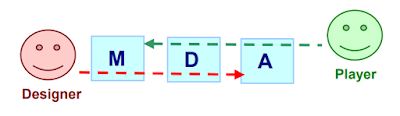
For this session I went about reading up on some MDA articles and posts(Mechanics, Dynamics, Aesthetics) and tried to understand the process of a developer on how to make a game compelling and 'fun' to play. Link Here Here is what I found the most interesting and useful MDA's are the formal way of approaching game design and research, these are usually displayed in the way of how rules dictate the way in which you play, how the system responds accordingly to you using the rules and how the 'fun' is displayed and had. This is the layman's terms of MDA. The mechanics dictate how the game is played, dynamics is how the game responds and aesthetics is how the game looks to have fun. I found this eye opening and very informative into how a game should be thought out and displayed in word form. This is also a formal language and can be taken in anyway possible to see how abstract your ideas can be. The 'fun' to be had can be divided into genres so to spe...

Language of Game Elements

Image
After browsing the readings about Game Design Language and understanding the point of this in relation for our projects I decided to give some opinions on this topic. Learning Game Design and Game Elements The Knowledge Guru Link  Here After reading the feature called  "Formal Abstract Design Tools"  it became clear that we, as in us gamer's and developers don't really have a language to describe games other than 'good or 'that was interesting'. This is shown in the post an is questioned and represented to us as a thing we should solve.I found this interesting as from what I've seen and experienced, I've never really felt that we had a deep 'formal' way of properly communicating to talk about games and their design. In a way we just talk about the way the games play or look but never but these two together On the second page of this  Feature , we go further into depth about this and I feel that we could be onto something here. We ca...

Thoughts and Notes on Reading about Game Design

Image
A fter spending some time looking over some the articles and websites about game design, I can safely say that these where really interesting, without a doubt. While some where actual speeches like "Don't be a Vidiot" by  Greg Costikyan link  Here ,  About how game designers can learn from non-electronic games by looking at how the rules and how the game is presented. Stuff like this is really interesting as it can give us pointers on what and what not to do. Life is a game, This is your strategy guide by Oliver Emberton Link  Here One I found interesting was called "Pull the plug: In defense of non-digital teaching and learning" Link  Here   as it was about how new game developers/ students should use non-electrical games to teach ourselves about how we can build a game from a simple concept; Like a pack of cards, there isn't a game specifically there until rules are introduced and messing with these rules can lead to a prototype of a game...